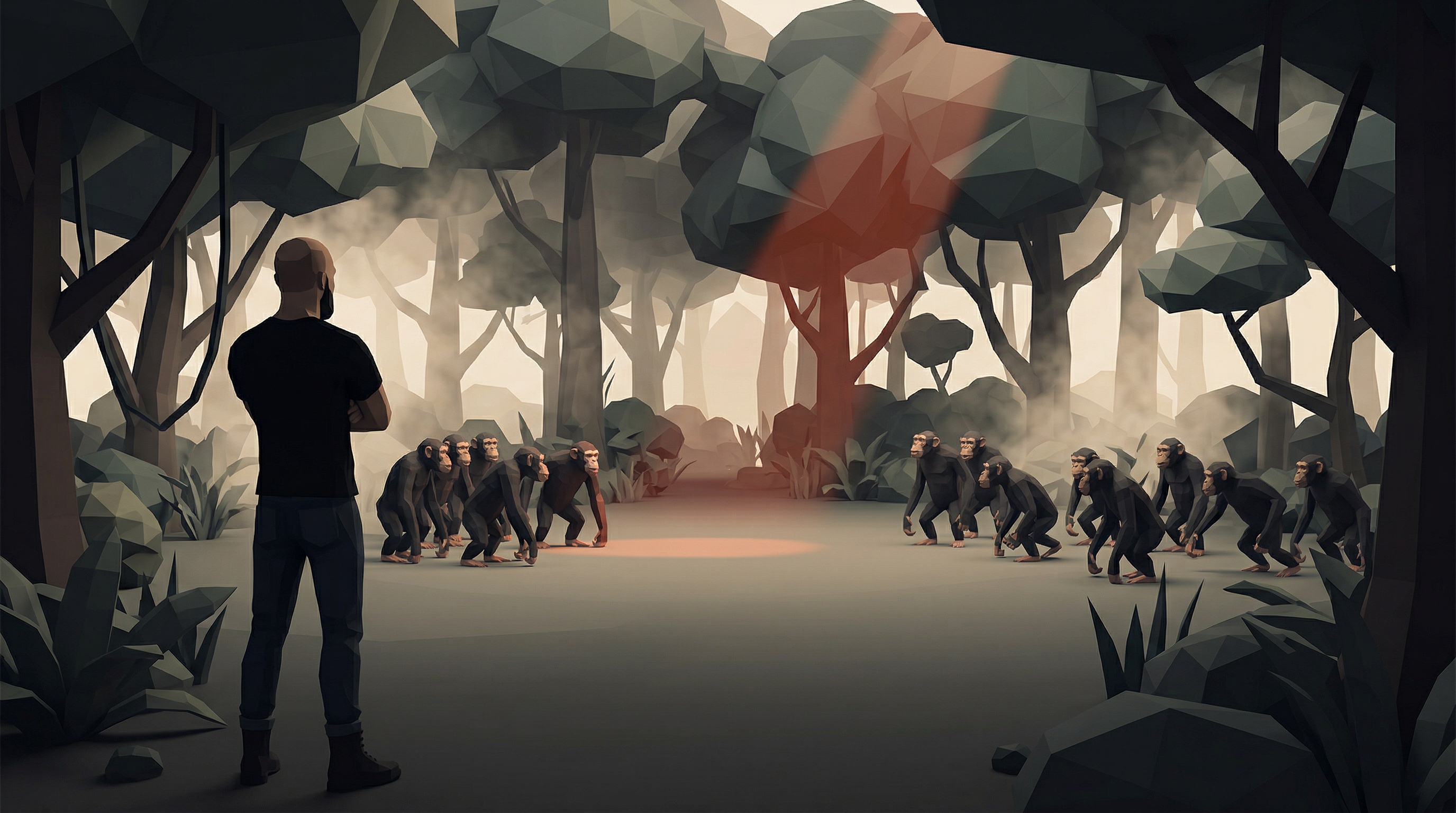
Scientists just published a chimp civil war study in Science. Every framework I've been teaching for twenty years is in it.
For 30 years, primatologists watched a community of 200 chimpanzees at Ngogo in Uganda's Kibale National Park. The largest wild chimp group ever documented. Stable. Cohesive. Then around 2015, something started to fracture.
Social ties frayed. Neighborhoods hardened into factions. Shared territory became contested border. By 2018, the break was permanent.
Over the next six years, the smaller faction raided the larger one and killed at least seven adult males and seventeen infants. Another fourteen adult and adolescent males from the losing side died or disappeared with no signs of illness. No disease. No accidents. Eliminated.
The killers weren't strangers. They were former companions. Groomers. Long-term social partners who turned on their old friends and hunted them.
The lead researcher, Aaron Sandel at UT Austin, called it what it is. Civil war. He estimated it happens once every 500 years in chimpanzee populations.
Sandel: "If we zoom in on interpersonal relationships and conflict management, we might find more effective interventions for peace."
He wants peace. I want unbreakable men. Different goal. Same layer.
That layer is where every framework in my body of work operates. Three Roads. Tribalnomics. Alliance Lifecycle. Parasite Killer. Leadership Manual. Dominion Cycle. All of them branch off one root. Pressure to Power. Pressure that doesn't get converted becomes violence. Ngogo is a nine-year case study in pressure nobody converted.
Watch what those chimps did. Watch what your tribe does. Then change what you do starting today.
Road Two Without Road One Produces Exactly This
The Three Roads are sequential. Self. Tribe. Value. In that order.
A man who walks Road Two without first walking Road One builds a group identity without a personal one. He merges into the collective because he has nothing of his own to bring. When the collective fractures, he fractures with it. He doesn't fight for a mission. He fights for whichever sub-group his body happens to be standing near.
That is Ngogo. Two hundred chimps, zero Road One identity, pure tribal pattern-matching. When the proximity-based neighborhoods started forming, there was no mission holding them together. Just feelings. And feelings always pick sides based on who's closest.
Dunbar's number caps tribal cohesion at about 150 relationships. Ngogo crossed it. Without a mission, crossing Dunbar is a death sentence.
A tribe without a mission cracks at 150. Every time.Overlap Collapsed. Offset Went Tribal.
Overlap is what a tribe shares. Direction. Values. Mission. Offset is what keeps you individual inside the tribe. Your unique contribution.
Healthy tribes maintain both. Too much overlap and individuals dissolve into the group. Too much offset and the group can't move together.
At Ngogo, overlap collapsed slowly from 2015 to 2018. The shared direction stopped being shared. And when overlap goes, offset doesn't disappear. It re-clusters. Sub-groups form new, smaller overlap circles around their own neighborhoods. Those circles start defining themselves against each other instead of alongside each other.
That is the civil war mechanism. It's not the absence of loyalty. It's the reassignment of loyalty.
The Western chimps didn't stop being loyal. They became loyal to a smaller circle. Their old friends became outsiders because a new inside was drawn around them.
This happens in your business. In your church. In your marriage. In every group of men who once worked toward something and stopped remembering what it was. The loyalty doesn't vanish. It redirects. And when it redirects without a mission to aim it, it aims at whoever is closest when the music stops.
The Commensal Stage Is The Actual War
My Parasite Killer framework classifies relationships on three tiers. Mutualistic, where both sides invest and both sides benefit. Commensal, where one side benefits and the other is indifferent. Parasitic, where one side benefits and the other pays the cost.
The protocol is clear. At the commensal stage, apply pressure immediately. Restore mutualism or expose parasitism. Don't wait.
Ngogo from 2015 to 2018 was three years of commensal slide. Relationships that used to feed both sides stopped feeding one side. Nobody applied pressure. Nobody tested. Nobody forced a conversation about whether the alliance still meant anything.
Chimps can't. They have no language for it. No protocol. No coach asking them the hard question at the right moment.
You do.
The commensal stage is where the war is actually won or lost. By the time it's parasitic, you're just cleaning up.Every time you let a commensal relationship sit, you are rehearsing Ngogo. You're permitting the slow fracture to happen in your own life because calling it out feels worse than ignoring it. Then six months later you wonder how you ended up with enemies you used to grill with.
The Repair Window Closes. Then It's Over.
Alliance Lifecycle has six stages. Formation. Maintenance. Repair. Expansion. Reforging. Expiration.
Repair is the stage where fractures get fixed. It comes before Expansion because you cannot expand what is cracked. You will multiply the crack.
The Ngogo Repair window opened in 2015 and closed in 2018. Three years. Nobody walked through it. Once it closed, the only remaining path was Expiration. And without the protocol for a clean Expiration, the expiring party got eaten instead of released.
Your alliances have Repair windows too. They don't announce themselves. They show up as weird silences at dinners you used to look forward to. As inside jokes that used to land and now feel forced. As a business partner who stops answering texts as fast as he used to.
Those are not vibes. Those are Repair stage alerts. Ignore them and you will be standing where the Ngogo Central males were standing. Confused that the friendship is suddenly something else.
No Leader Made The Cut
My Leadership Manual has seven protocols. Two of them are load-bearing here.
Protocol Two. Maintain mission clarity. The leader is the compass, not the emotional regulator. When mission gets fuzzy, the leader's only job is to reassert it hard enough that the fracture has nowhere to hide.
Protocol Six. Decide by cutting. Deciding means eliminating options. A leader who refuses to cut lets the group do the cutting for him. Groups cut with violence.
Ngogo had no organic leader holding mission. No de facto leader willing to make the call. So the group cut itself. Slowly at first. Then all at once.
If you are the leader of a tribe and you are watching a fracture you will not name, you are the Ngogo Central alphas. You just don't know it yet. The cut will happen without you. It will just cost more.
The Full Dominion Cycle In Nine Years
My Dominion Cycle framework maps four arcs. Surplus. Slave Mind. Scarcity. Master Mind. Then repeat.
Ngogo ran the entire cycle in nine years. Surplus at the start, 200 chimps thriving in abundant Kibale territory. Slave Mind as standards eroded and nobody enforced mission over comfort. Scarcity as factions formed and violence increased. Master Mind as the Western group rebuilt dominance on colder, harder ground.
Sandel says once every 500 years for wild chimps. For humans it is faster, because we compress cycles through language and institutions. The structure is identical.
Every tribe you have ever been part of is somewhere in this cycle. Knowing where you sit tells you what is coming next. Most men refuse to look because the answer is uncomfortable.
What You Have That Chimps Don't
The gap between you and those chimps is language.
Chimps cannot talk. They cannot run a Repair protocol. They cannot classify a relationship as commensal and force a conversation about it. They cannot reassert mission in a room and watch the fracture burn off. They have no Leadership Manual. They have no way to cut cleanly.
You have all of that.
But the deeper difference isn't the tools. It's identity. A man who walks Road One first doesn't get swept into proximity-based tribal fracture, because his identity isn't on loan from the group. Chimps have zero Road One. And most men are closer to chimps on this than they want to admit. They borrow identity from the tribe, then go to war for the tribe when the tribe splits, because they have nothing of their own to defend.
Every framework in my body of work is a tool those chimps didn't have. And most men, given those tools, still refuse to use them. They sit on commensal relationships until they go parasitic. They ignore Repair windows until the windows close. They go vague on mission because asserting it feels aggressive. They let sub-tribes form inside their own house because confronting it feels risky.
Then one day their tribe fractures and they call it a surprise.
It isn't a surprise. It's Ngogo. On your schedule. In your house.
Run The Audit This Week
First answer one question about yourself. Are you walking Road One? Own identity, own standards, own mission above any tribe's? If not, the rest of the audit is theater. You cannot lead a tribe you have not brought yourself to.
If Road One is intact, run the four questions on every alliance that matters to you.
- Mutualistic or commensal? If commensal, apply pressure this week. Restore it or expose it.
- Is the Repair window open or closing? If closing, have the conversation now. Not next month.
- Is overlap intact or reassigning? If men around you are forming smaller circles you're not inside, name it out loud.
- Is the mission clear or sentimental? If sentimental, reassert it hard. Watch who flinches.
Answer the questions. Act on the answers. That is the entire difference between you and a chimp who got groomed for a decade by the male who eventually killed him.
Movement is mandatory. The direction is up to you.
~MC
PS: Two hundred chimps couldn't save themselves because they had no language for the fracture. You have the language. Use it before the Repair window closes.